
Dehumidification and Humidification
Temperature is only half the comfort equation. Humidity — how much moisture is in the air — has an equally powerful effect on how a home feels, how healthy it is, and how well the building holds up over time. Too much humidity and the air feels heavy, mold takes hold, and comfort disappears. Too little and skin dries out, wood shrinks, and respiratory irritation sets in. The ideal range is narrow — and keeping it there year-round requires active control.
When the air is too heavy
Excess humidity is one of the most common and damaging comfort problems in residential buildings — especially in humid climates, basements, and tightly sealed homes. High humidity makes a room feel warmer than it is, promotes mold and dust mites, and causes structural damage over time. Active dehumidification removes that excess moisture and restores comfort.
Your radiant system already has everything it needs to dehumidify.
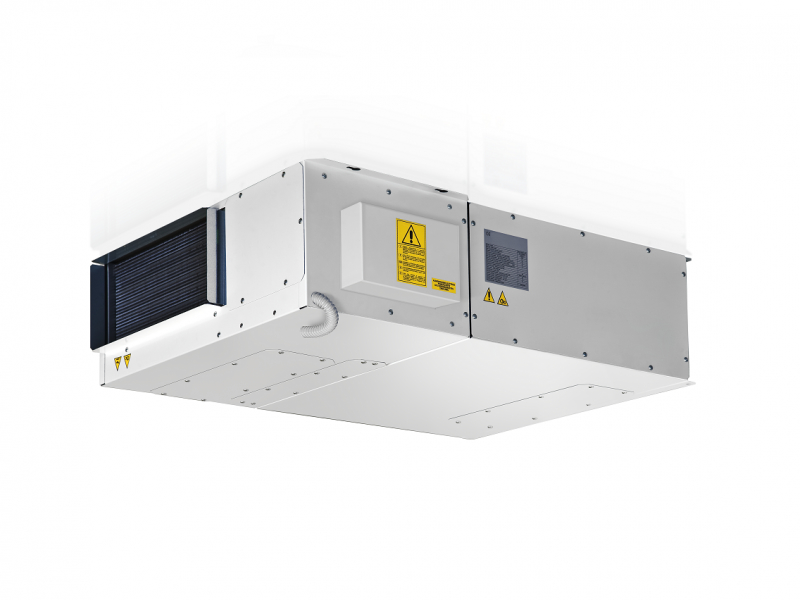
When a Messana radiant system runs in cooling mode, it circulates chilled water through the floor or ceiling surfaces. That same chilled water circuit can be connected to a hydronic dehumidifier — a unit that pulls warm humid room air across a chilled coil, condenses the moisture out of it, and returns dry conditioned air to the space. No separate refrigerant circuit, no separate compressor. The radiant system does the heavy lifting and the dehumidifier removes the moisture — two functions, one hydronic circuit.
Connected to radiant system
Hydronic dehumidifier
Uses the chilled water circuit
Connects directly to the Messana chilled water circuit. No separate compressor — the radiant cooling system provides the cold source. Quieter, simpler, and fully integrated with mSense control.
Independent unit
Standalone dehumidifier
Self-contained refrigerant cycle
A self-contained unit with its own refrigerant compressor. Works independently of any hydronic system — ideal for renovation projects, basements, or spaces where a radiant cooling circuit is not present.
Humidification
When the air is too dry
In cold climates and during winter months, heating systems dry the air significantly — often dropping relative humidity below 30%. At these levels, the effects are immediately noticeable and medically significant. Active humidification restores moisture to the air and brings indoor conditions back into the healthy range.
“Humidity control is not a luxury — it is the difference between a house that feels right and one that never quite does, no matter what the thermostat says.”
Why choose Dehumidifier and Humidifier for your project:
If your home is in a humid climate — or anywhere that summer humidity makes the air feel heavy and promotes mold — a dehumidifier keeps indoor moisture in the healthy range automatically; and if you live where winters are cold and heating dries the air below comfortable levels, a humidifier protects your health, your sleep, and your wood floors through every cold month — together they ensure your home feels right no matter what the season brings outside.